Sunday, April 20, 2014

History of Math: Fibonacci Sequence


Fibonacci was an Italian mathematician who is sometimes considered to be the most talented western mathematician of the Middle Ages.  Fibonacci (Leonardo Pisano Bigollo) was also known as Leonardo of Pisa, Leonardo Pisano, Leonardo Bonacci, and Leonardo Fibonacci.  While Fibonacci is best known for spreading the modern (Hindu-Arabic) numeral system in Europe through his 1202 Liber Abaci (Book of Calculation).  Fibonacci, also in his Liber Abaci, introduced a problem about the growth of a population of rabbits.  The solution was a sequence of numbers (later named the Fibonacci numbers or Fibonacci sequence).

The Fibonacci sequence was known in the 6th century, yet Fibonacci gets the sequence named after him because he is the one that introduced it to the west.  The sequence involves adding the last two terms in the sequence in order to achieve the new term, written as F(n+1)=F(n)+F(n-1).  However, although Fibonacci brought it to the “new world” he did change it a bit in his interpretation.  Some people of the time (and most today) started the sequence with 0, 1, 1, 2, but Fibonacci changed the sequence to start with 1, 1, 2, which in the “long run” does not change anything but the numbering of the terms.  Fibonacci did his calculation to the thirteenth place which is 233.

Using the Fibonacci sequence, the Golden Spiral can be made.  Using the Fibonacci numbers as guidelines, you can make squares that continually grow.  Then, connecting corner to corner with an arc, a spiral can be made.  The reason that this spiral has a special name, the Golden Spiral, is because in order to make this spiral, the dimensions are based off of the golden rectangle.  The golden spiral follows the golden ratio which is equal to


The golden ratio is also found below in this conch shell. 


However, how would you answer the problem, how do the Fibonacci sequence and Pascal's Triangle relate?  Give an example such as 89 to help with understanding?  After some research, you may find that the Fibonacci sequence is made up of the additions of Pascal's Triangle's angles.  Each line, always drawn parallel to the last, will make up the next number in the Fibonacci sequence.  So with Pascal's Triangle and the Fibonacci sequence in hand, errors can be checked for on both.  A good example is the number 89.  89 is the 11th number in the Fibonacci sequence.  This number is attained by adding 55 and 34 from the Fibonacci sequence.  Using Pascal's Triangle, 89 is attained by adding 1, 9, 28, 35, 15, and 1 (found below)
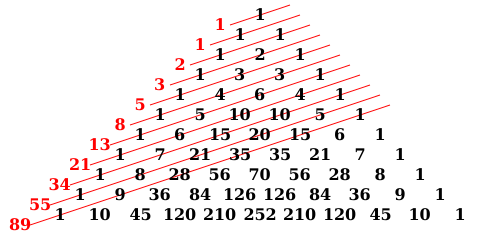


From this we can see that not only is the Fibonacci sequence important, it also have many practical applications.  The sequence is easily attainable for anyone that can do simple arithmetic.  It seems like such a simple sequence, but it has such large applications.

Communicating Math: Book Review: The Math Book by Clifford Pickover

The Math Book by Clifford Pickover was a good read.  The book goes through history and talks about the relevant mathematical findings.  Pickover starts from c. 150 million years B.C. and works his way up to 2007.  Pickover, in his introduction, states that he realizes that some of the discoveries not mentioned may be more important than the ones that he states, but this is his own opinion on the most significant findings and the ones he enjoyed learning about the most.

The book has a good structure.  Each new page is a new "section" and is completely independent from the previous or next page.  Each page also has an accompanying picture that, in some ways, tries to help the reader in their understanding of the subject.  Pickover, in each entry, tries to give some background about the subject and who discovered it and also tries to explain some what the discovery did or is doing for math now.  Each section is short and easy to read, which makes the book a fast read and not too time intensive to read through.

The book did some things well.  The book did a good job going over many topics (249 in total) relatively fast and briefly.  This book gives the reader a good sense of what has been done in math since c. 150 million years B.C.  The book also does a good job trying to link together many of the subjects talked about.  Each page has bolded words that refer the reader to other passages with similar context or to help the reader with an understanding on how the discovery was made (usually due to something earlier in the book).  At the end of each page, you can use the references to find other similar works if reading this book for a leisure read and wanting to gain more knowledge on a specific topic.  Pickover does do a good job of explaining who discovered each mathematical finding too.  He gives a very brief history on the person (i.e. who they are, their nationality, their race/religion, etc.) so that the reader can gain a respect for the breadth of math.  I believe that Pickover does this because he wants the reader to understand that math is discovered everywhere and by all types of people, yet sometimes he can bog down the reader with the details.  The most interesting part of this book, which was sometimes the most frustrating too, was the "paradoxes" and "problems" that Pickover places in the book.  I had an easy time understanding some of the "paradoxes" and/or "problems," but other times, like other sections, I just had no idea what was going on and so I would just skim over the reading and not understand it.  The "paradoxes" and "problems" that I did understand were very interesting though.  I found myself waiting to read the answer until giving myself sufficient time to try and find the answer (or have a guess) myself.  It made the book more fun to read and gave a break from the strictly math sections of the book.

The book also has many things that I would change.  There are frequently (more so toward the end of the book) pages and sections that I would leave out entirely.  For the standard student, some sections are either WAY over their head, way to rudimentary, or just plain boring.  The book would therefore go into way too much detail or just not enough at all.  I found that some sections I would finish the page description and leave with a "what?" or "I don't understand this at all" feel.  After talking to some other students reading the book, they felt the same way.  On the other hand, the pages that were just plain simple, I felt like the discovery was important, but the details not so much because they are self explanatory (i.e. a least squares line he goes into a two paragraph description of what it is).  Another thing that I would change about the book is the amount of background given for each section.  Sometimes the amount of background given for a particular section would overtake the math of the section and cause me to miss the overall reason for the section in the book.  The background, while I understand is sometimes necessary, would just be too in-depth.  A more brief background would have benefited me more and then if I was interested in the subject I would look up more.  The last thing that I did not like about the book was the amount of quotes given from other mathematicians about a particular work.  These added nothing to the sections.  Sometimes it seemed that Pickover would add these quotes just because he realized that a finding was important, but didn't understand if fully and so he would take up space on the page with these quotes.  I found that by the end of the book, almost any time something was quoted from some other mathematician I would completely skip the quote because it added nothing to my understanding and was a waste of my time to read it.

While it may seem that I had a lot of complaints about the book, I did highly enjoy reading it.  I found that as I was reading about things I would be able to link them to other things I have learned in math.  I also enjoyed learning about the history of math from another perspective.  If you can get past the critics I have on the book, I would suggest reading this book, as it was not a hard read and had some very interesting topics.

Commicating Math: Book Review: e: The Story of a Number by Eli Maor

I read e: The Story of a Number by Eli Maor.  This book was a very fast read.  The book was laid out in a very easy to read format, with each chapter talking about the history of some aspect of math.  At the end of each chapter there was a short section on some of the derivations that were talked about in the chapter.  The back of the book had additional appendices to show more derivations and show how some other parts of the book were concluded.

I liked the layout of the book.  Just talking about the history of a discovery and some of the most essential math in the actual chapters of the book was a good move by the author.  This helped focus the chapter on the essentials of the history.  It also allowed for those that have less mathematical background in general or on a specific subject to be able to finish a chapter and understand what the key messages were.  Adding the additional parts at the ends of chapters and the appendices were also good, because those that have more background in the subject or want to know more could go and look at those sections and find the derivations.  Personally, there were some that I looked at, and others that I found less interest in and just skipped over because I was not interested in the topic.

As far as the content goes, I found the book to be VERY interesting.  I chose this book by the recommendation of Duncan Vos and because I knew that being a science major as well, learning more about the number e would be more helpful than many other things that I could have chosen to read.  The history behind the number e is very long.  It has many twists and turns that finally get to the ending value of 2.7182818284. The naming of the number also took many years, it was initially called just the inverse of the logarithmic function, but Leonard Euler (of course) was the one that gave it the letter e.

The book was a definite good read, but I would not suggest it to everyone. The material is very interesting to those that like to learn the history/origins of numbers and ideas, but if that is not your favorite thing to read about, I would shy away from this book. A major flaw of the book comes in that aspect, in that, the author talks about feuds between families and the discovery of calculus, but doesn't do a great job tying all of the aspects of the book together well. He gets all the major discoveries that lead up to the number, but again, unless you have background knowledge in the area of e or enjoy having a history lesson, the book is not for you.

Doing Math: Magic Birthday Square

After class time on April 8th, I found one particular problem of Ramanujan both interesting and completely unfair.  I know all of the people in class that day felt the same way.  We were going through many of his accomplishments when it was shortly brought up that Ramanujan had a magic square that he had made out of his birth-date.  It made me wonder... Can any birth-date be made into a perfect square?  So of course I gave it my own go.  Luckily with today's technology, doing this is much easier than it had to have been in the past.  With the simple power of Microsoft Excel's "SUM" tool I could easily know if my perfect square would work.

I first started with my birthday, October 23, 1991 (10-23-1991), which adds up to be 143 (10+23+19+91).  So far the table is pretty empty, but it looks like the following,


10
23
19
91
-
-
-
-
-
-
-
-
-
-
-
-


I was trying to figure out what to do next.  I began with a simple guess.  I knew that all the squares (including the top left 2-by-2 square) had to be 143, so I took 19, added 1 to it and took 91 and subtracted one, leaving me with 90 and 20.  Now came the time for a decision, where to place the numbers.  I looked at the numbers and thought to try putting the larger number with the smaller number and vice verse.

10
23
19
91
90
20
-
-
-
-
-
-
-
-
-
-

So now I knew that the top left corner square was 143.  So again I went with what I thought to be a good educated guess.  I looked at the top right corner now.  I knew that the numbers need to add to be 33 so I first tried to do 32 and 1, with the same strategy as before, I thought to put the bigger number underneath the smaller number from the first row, so my magic square then looked like the following,

10
23
19
91
90
20
32
1
-
-
-
-
-
-
-
-

I was beginning to feel like I was getting somewhere.  I now had to take one more guess and the rest of the numbers should fall into place if they were to be right in this configuration, otherwise, I would have to start again.  I knew that the first vertical line was so far at 100 and I needed to get to 143, I also knew that the second vertical line was at 43 and needed to get to 143.  I took a wild guess and said why not try 2 and 98 for the two numbers for the second vertical line, I chose that it would be 2 then 98 in the vertical sense because I knew from the top that 23+19 was only 42, so it needed a lot more to get to be 143, so I was at,

10
23
19
91
90
20
32
1
-
2
-
-
-
98
-
-

I now knew 3 of the 4 squares from the square that makes up the middle two top numbers and middle two bottom numbers.  I did some simply subtraction (143-(23+19+98)) and found that the last number needed to be 3 in order to complete that square. I filled that one in next.

10
23
19
91
90
20
32
1
-
2
-
-
-
98
3
-

Since the vertical was now almost complete, it was only crucial to fill in the number above 3.  So I found what 143-32-19-3 is 89.  This now completes the third vertical row.

10
23
19
91
90
20
32
1
-
2
89
-
-
98
3
-

Next I will figure out the middle right square.  Since there is already a 32, 1, and 89, then 143 subtracted by those leaves 21.  So that gets filled in there and with that entry, there is the bottom right most square that can be filled in, subtracting 143 by 89, 21, and 3 leaves 30.  So we will fill those in below.

10
23
19
91
90
20
32
1
-
2
89
21
-
98
3
30

Using the same method, the two squares on the left can be filled in.  The middle left most square is then filled in with 31 since 143-(90+20+2) and then with that filled in the bottom left most square is filled in with 12 since 12=143-(31+2+98).  So the final square turns out to be as follows

10
23
19
91
90
20
32
1
31
2
89
21
12
98
3
30

After being elated that I found a magic square for my own birthday, I began to check myself.  I realized at that moment that my magic square was not completely correct.  I looked at the diagonals and the bottom and top middle squares and realized that these 4 sets did not add to the magic 143 number.  I tried for quite some more time, but did it to no avail.  I then questioned the thought that my birthday had a magic square.  I tried more numbers and worked through the problem the same way.  The first guesses turned out to be the closest I could get out of my 30 tries.  I then ended my trails at a magic birthday square believing that my birthday (along with the possibilities of many others) did not have a magic square associated with it.