History of Math: Fibonacci Sequence
Fibonacci
was an Italian mathematician who is sometimes considered to be the most
talented western mathematician of the Middle Ages. Fibonacci (Leonardo Pisano Bigollo) was also known
as Leonardo of Pisa, Leonardo Pisano, Leonardo Bonacci, and Leonardo
Fibonacci. While Fibonacci is best known
for spreading the modern (Hindu-Arabic) numeral system in Europe through his
1202 Liber Abaci (Book of Calculation). Fibonacci, also in his Liber Abaci, introduced a problem about
the growth of a population of rabbits.
The solution was a sequence of numbers (later named the Fibonacci
numbers or Fibonacci sequence).
The Fibonacci
sequence was known in the 6th century, yet Fibonacci gets the
sequence named after him because he is the one that introduced it to the
west. The sequence involves adding the
last two terms in the sequence in order to achieve the new term, written as
F(n+1)=F(n)+F(n-1). However, although
Fibonacci brought it to the “new world” he did change it a bit in his
interpretation. Some people of the time
(and most today) started the sequence with 0, 1, 1, 2, but Fibonacci changed
the sequence to start with 1, 1, 2, which in the “long run” does not change
anything but the numbering of the terms.
Fibonacci did his calculation to the thirteenth place which is 233.
Using the
Fibonacci sequence, the Golden Spiral can be made. Using the Fibonacci
numbers as guidelines, you can make squares that continually grow. Then,
connecting corner to corner with an arc, a spiral can be made. The reason
that this spiral has a special name, the Golden Spiral, is because in order to
make this spiral, the dimensions are based off of the golden rectangle. The golden spiral follows the golden ratio
which is equal to

The golden
ratio is also found below in this conch shell.

However, how would you answer the problem, how do the Fibonacci sequence and Pascal's Triangle relate? Give an example such as 89 to help with understanding? After some research, you may find that the Fibonacci sequence is made up of the additions of Pascal's Triangle's angles. Each line, always drawn parallel to the last, will make up the next number in the Fibonacci sequence. So with Pascal's Triangle and the Fibonacci sequence in hand, errors can be checked for on both. A good example is the number 89. 89 is the 11th number in the Fibonacci sequence. This number is attained by adding 55 and 34 from the Fibonacci sequence. Using Pascal's Triangle, 89 is attained by adding 1, 9, 28, 35, 15, and 1 (found below)
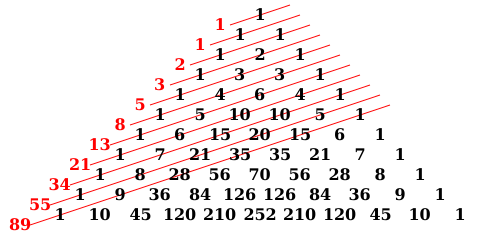
From this we can see that not only is the Fibonacci sequence
important, it also have many practical applications. The sequence is easily attainable for anyone
that can do simple arithmetic. It seems
like such a simple sequence, but it has such large applications.
posted by Kenton Shaw @ 7:22 PM
0 Comments


0 Comments:
Post a Comment
Subscribe to Post Comments [Atom]
<< Home